

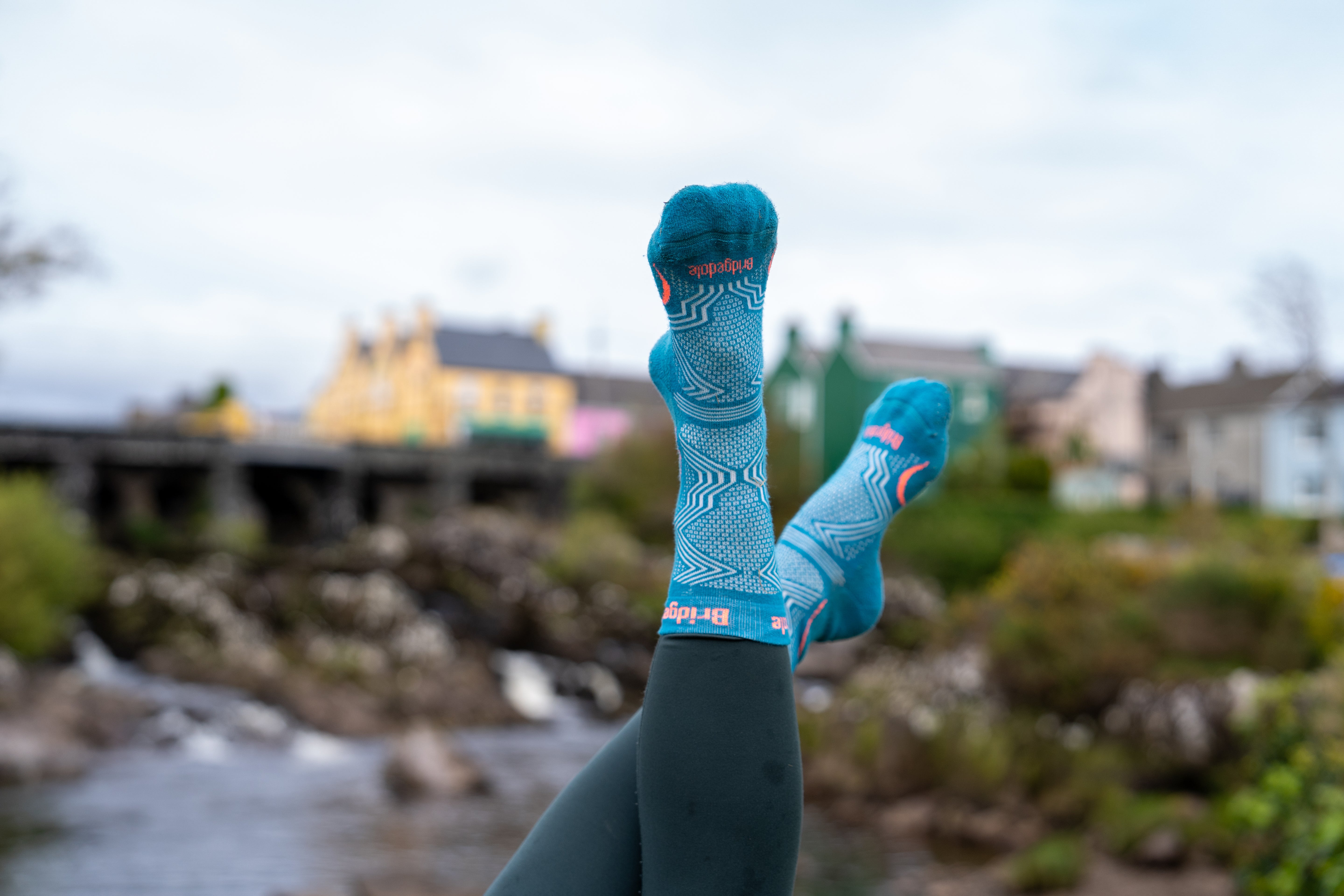
Most hikers will spend more time researching boots than socks. What you don't realise is they are both just as important. A boot can be exactly right and still leave you limping by mile six if the sock inside is wrong — too loose and it bunches, too tight and it cuts off circulation, wrong shape and it moves when your foot doesn't. Getting your hiking sock fit right isn't a footnote to comfort. It's the whole point.
The good news: We've made it easy for you to understand all this sock talk.
Comfort vs Performance Fit: Which Do You Need?
Our hiking socks have been engineered to give you the choice. 'Performance' and 'Comfort' are the styles we've designed, so you can decide whether you like a fitted cuff or a bit more flexibility.
The original 'Performance' fit
This suits the big time hikers, longer distances, technical terrain, and serious routes where a sock needs to behave like part of the boot. A closer, more supportive fit, engineered to mould to your foot and leg.
Our 'Comfort' cuff fit
This generally suits the walkers and everyday strollers as it has a relaxed cuff that can worn up or down. It's got all the same cushioning as our 'Performance' style, it's just about your preference.
If you have Diabetes or Circulation issues, this is the perfect style to keep you comfortable as the relaxed fit stops that restrictive feeling.
Neither is "better." It's all about preference. One is built for the sofa-to-summit day out. The other is built for the person who's still walking after everyone else has stopped.

Understanding Bridgedales Features
This is where our sock engineering makes a big difference. A good hiking sock fit isn't one thing — it's a handful of features working together:
-
Arch Support
— an Elasticated Arch & Forward Flex, structured band through the mid foot that keeps the sock locked into position. Bye bye rubbing, bunching, and rucking. -
Heel Locked in
— our Y-Heel creates the perfect shape around the heel to prevent slippage, and excess bulk, which is where you need comfort. -
Cushioning Zones
— advanced padding system, where cushioning is tactically placed to where impact actually happens, rather than basic padding throughout. -
Almost Invisible Seam
— our Flat Toe Seam means it's also your toes that are comfortable, and stops any irritation.
None of these work in isolation. A sock with great cushioning and no technical features will still slip. Fit is created through a build up of features.
Men's vs Women's Hiking Sock Fit: What's Actually Different
This isn't a colourway decision. Men's and women's hiking socks are built genuinely different, because feet aren't unisex to begin with.
-
Heel width
— women's socks are typically shaped for a narrower heel, reducing the internal volume that causes slippage. -
Arch placement
— women's arches tend to sit slightly differently along the foot, so support bands are positioned accordingly. -
Overall volume
— men's socks are built with more room through the forefoot and instep to match typically broader foot volume.
But not all feet are dainty. If you feel like you're a woman with wider set feet or a man with a slimmer structure, then there's no reason why you can't chose the alternate option.

Matching Cushioning & Weight to Your Walk/Hike
| Sock Weight | Best For | Footwear Match | Unique Features | Fit |
| Heavyweight - Knee & Boot sock options | Mountaineering, icy cold environments, cold weather hiking | Mountaineering boots, hiking boots, winter boots | Full Cushioning - Extra warmth | Performance fit (close fit) or Comfort fit (relaxed fit) |
| Midweight - Boot & Ankle sock options | All-round, 3-season hiking, treks, camping, hill walking, country walking | Hiking boots, trail shoes, hiking shoes, low shoes for ankle lengths | Flat Toe Seam, Forward Flex, Elasticated Arch | Performance fit (close fit) or Comfort fit (relaxed fit) |
| Lightweight - Boot, 3/4 Crew & Ankle options | Warm Spring hiking, treks, camping, hill walking, country walking | Hiking boots, trail shoes, hiking shoes, low shoes for 3/4 & ankle lengths | Flat Toe Seam, Elasticated Arch, Added ventilation (in selected styles) | Performance fit (close fit) or Comfort fit (relaxed fit) |
| Ultralight - Boot, Crew, Ankle & Low options | Warm Summer hiking, treks, camping, hill walking, country walking | Hiking boots, trail shoes, hiking shoes, low shoes for low & ankle lengths | Over foot added ventilation, T2 Anti-shock cushioning, Flat Toe Seam | Performance fit (close fit) |
| Liners - Boot options | Multi-day treks, overnight hiking/camping, mountaineering | Hiking boots, trail shoes, hiking shoes | Coolmax®, thermal & Merino wool options | Performance fit (close fit) |

